
River Rafting
Hey Friends, nice to meet you again on 78mm Adventures Blog. As we told you in the last post that we will share the descriptive of every Adventure Sport. So, we are here with our next sport i.e. Rafting.
To recapitulate, River Rafting is a water sport. Enthusiasts use an inflatable raft to cross a river. As we all know, India has many places (rivers) where you can enjoy rafting at its best. Black Water Rafting and White Water Rafting are the two ways to enjoy rafting. However, White Water Rafting is famous in India. One can do rafting on various degrees of rough water in order to experience the fun and excitement at the best.
One can do rafting on various degrees/classes of rough water in order to experience the fun and excitement at its best. These degrees can be classified as
Effortless: Enthusiasts cross low waves, small rapids and slow current with basic skills of rafting. This section doesn’t require any special technique.
Fair: This class demands basic skills for rafting to steer faster currents.
Hard: Hard class, which has rough currents, ask requires strategy and veteran paddling skills.
Extremely hard: You must be an experienced paddler to cross rocks and violent water currents.
Tremendously tough: One needs advance skills to face the challenges of this class like deep rapids with hefty volume which makes this class comparatively dangerous.
Exceptionally grueling: As the name defines, this is the most dangerous class with extensive whitewater, gigantic waves, huge rocks and hazards. This class demands fate more than experience as experts say, “Winning this class without serious injury or death is simply a matter of great luck or extreme skill.”
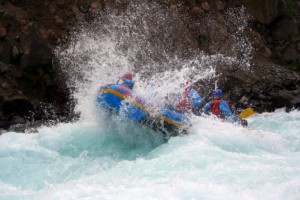
From aforementioned degrees/classes of rough water, it becomes quite obvious that rafting demands loads of stamina and strength. And that is the reason rafting has its own precise techniques to tackle the watery obstacles.
Paddling: This technique is all about team performance. To cross the water obstructions, paddlers need to give enough speed to the raft while maintaining it’s balanced with equal number of paddlers on its both sides.
High siding: This technique could be opt if raft turn over on its inside edge. The rafters have to mount on the side of the raft furthest downstream.
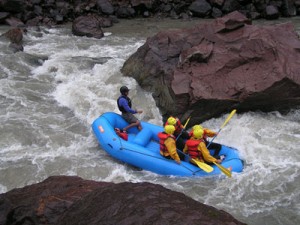
After discussing all the difficulty level and techniques, let’s talk about safety measurements while rafting. White Water rafting could be risky, if main and basic safety precautions are not observed. The most simple and best way to keep injuries away while rafting, is to swim to an Eddy, which is a calm place on the back of a rock in the water where the current disperses in order to avoid being taken downriver. But above all every security measure, it is highly advisable to take experienced guides along with you while going for rafting.
Teesta River, Sikkim; Beas River, Himachal; Ganges River, Garhwal, Uttranchal are the few examples, where you can enjoy rafting and have fun being closer to water then being on a raft. So don’t just imagine yourself crossing the river waves with a raft, pack your bags and step out of your home.
Happy Holidays!!!!!!
This article and its surviving images were recovered from the old 78mm Adventures blog and converted into a static page. The archived comments feed contained no visitor comments for this post.